|
Bottom-up Factors Influencing Riparian Willow Recovery in Yellowstone National Park.
Michael T. Tercek1, Robert Stottlemyer2, and Roy Renkin3
1. Walking Shadow Ecology, PO Box 1085, Gardiner, Montana, 59030, Email: Tercek@YellowstoneEcology.com
2. US Geological Survey, Fort Collins, Colorado, 80526
3. Yellowstone Center for Resources, National Park Service, Yellowstone National Park, Wyoming 82190
Abstract
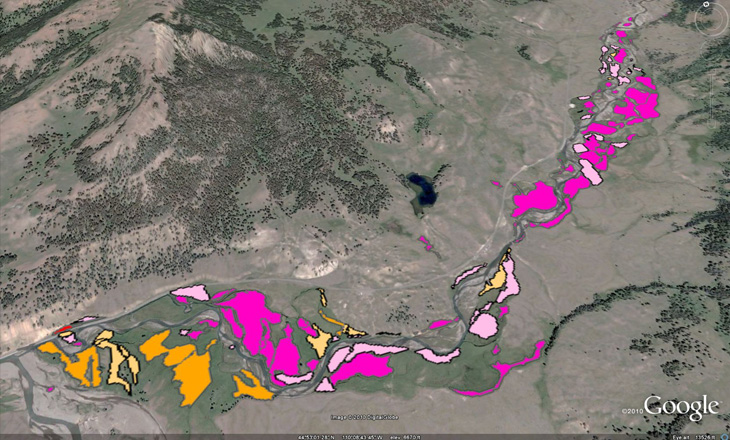
After the elimination of wolves in the 1920s, woody riparian plant communities on the northern range of Yellowstone National Park (YNP) declined an estimated 50%. After the reintroduction of wolves in 1995-1996, riparian willows on YNP’s northern range were reported to show significant growth for the first time since the 1920s. The pace of willow recovery has not been uniform. Some communities have exceeded 400 cm while others are still at pre-1995 levels of less than 80 cm mean height. We intensively measured abiotic factors, including soil and water table characteristics, to determine whether these factors might be contributing to the varying pace of willow recovery. All of our study sites were "short" prior to 1995 and have recovered to varying degrees since. We contrasted "tall" willow sites that had escaped elk browsing with "short" willow sites (<250cm max. height) that could still be browsed. Unlike studies that manipulated willow height with fences and artificial dams, we examined sites that had grown natural differences in height since the reintroduction of wolves. Tall willow sites had greater water availability, more rapid net soil nitrogen mineralization, greater snow depth, lower soil respiration rates, and cooler summer soil temperatures than nearby short willow sites. Most of these differences were measured both in herbaceous areas adjacent to the willow patches and in the willow patches themselves. This suggests they were not effects of willow height recovery but were instead preexisting site differences that may have contributed to increased plant productivity. Our results agree with earlier studies in experimental plots which suggest that the varying pace of willow recovery has been influenced by abiotic limiting factors that interact with top-down reductions in willow browsing by elk.
|